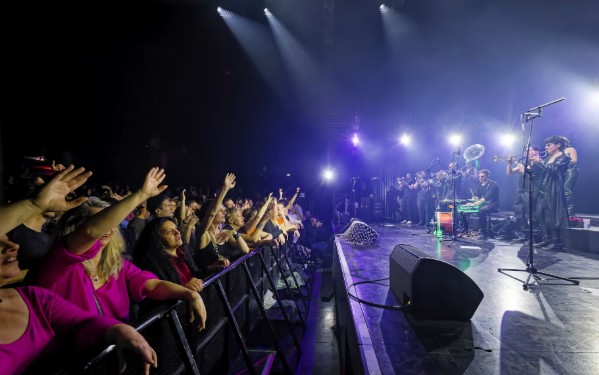
A memorable concert is engineered from the room outward. The artist supplies the songs, but sound coverage, sightlines, entry flow and the emotional order of the set determine whether those songs feel intimate or remote. Research on live performance has found faster audience head movement at a concert than during playback of the same songs. That does not reduce the night to a formula. It shows why two performances of an identical set can leave completely different memories: one room helps the crowd listen together, while another keeps every person fighting the space. The production question is how to make each change legible, not how to make every second louder.
The Room Is Part of the Mix
Low frequencies collect in corners, hard surfaces lengthen reverberation and a balcony can block direct sound. A competent design therefore aims for even coverage rather than maximum volume at the mixing desk. Delayed arrays can carry vocals to the back while acoustic treatment protects percussion and consonants.
Lyrics should remain intelligible when the arrangement becomes dense. If the chorus turns into a wall of bass and cymbals, the emotional peak has lost its shape. Even coverage preserves contrast between a restrained verse and a full-band release.
Loudness Has a Ceiling
The World Health Organization recommends a maximum average level of 100 dB LAeq over 15 minutes for venues and events. Its standard also calls for calibrated monitoring, optimised acoustics, hearing protection, quiet zones and trained staff. The limit does not eliminate all risk, but it gives operators a measurable ceiling instead of treating discomfort as proof of intensity.
Quiet space is part of the show design. Fans who step away and return can reach the final act with attention intact. Earplugs should be visible before the headline set.
A Set List Works Like an Emotional Map
Set order controls more than tempo. Familiar songs create recognition, new material asks for patience, and silence before an encore lets anticipation gather without another lighting cue. A 2022 study of live audiences linked interbrain synchrony mainly with moments of high musical pleasure, while group emotional cohesion could strengthen that response.
Artists need contrast, clean transitions and enough trust to leave a gap between peaks. If every song arrives at maximum brightness and volume, nothing feels larger than what came before.
The Second Screen Extends the Night
Digital leisure often begins after the venue lights rise, when fans are travelling home and no longer want a two-hour commitment. Casino browsing belongs to that short-session economy, but credibility depends on information rather than colour or sound. A search for online casino legit should lead players to inspect the named operator, account controls, game provider and published rules before staking. Slot outcomes come from RNG logic, and a displayed RTP describes a long-run theoretical return rather than what one session should produce. A fixed spending limit keeps a brief diversion from quietly becoming the most expensive part of the night.
Sport creates a different second-screen habit because the event itself supplies live information. Fans check line-ups, score changes and market movement, then compare the price with what they have watched. On a platform offering online betting, decimal odds can be converted into implied probability by dividing one by the price. A quote of 2.00 implies 50% before the bookmaker margin, while an in-play price may move after a goal, injury or tactical change. The useful skill is reading why a line changed, not assuming movement proves where it will finish.
Fast games borrow some of music’s strongest attention tools: anticipation, release and clearly timed feedback. Their short rounds can fit a commute, although audio cues do not alter the underlying probability. Opening Lucky slot gives access to the game, but the rules panel and stake controls should be checked before a paid round. A player should confirm how a round starts, how a result is settled and whether any automatic-play option is active. Sound can make an outcome feel dramatic; it cannot make the next result due.
Small Details Decide Whether Fans Return
The least glamorous production choices often survive longest in a fan’s memory:
- open doors early enough to prevent the support act playing to a queue;
- keep sightlines clear around bars, pillars and accessibility platforms;
- publish set times and transport information before arrival;
- place water, hearing protection and quiet areas where people can find them;
- train security to solve crowd-flow problems without escalating the mood.
None of these details replaces a strong performance. Together, they stop friction from competing with it.
Record the Room, Not Just the Stage
A desk-only live recording can sound unnaturally dry because it misses the audience and room. Ambience microphones preserve applause, collective singing and the silence before a song lands. Engineers must still control delay and phase.
That recording becomes the final audit. If the vocal disappears when the band grows louder, if applause overwhelms speech or if the back of the room arrives late, the mix reveals where the next show needs work. The most useful post-concert note is not that the crowd was loud; it is where, when and why the room helped it become one.