
Almost everyone has a degree now, and that’s kind of the problem. Go to any job fair, or honestly just scroll through LinkedIn job posts for ten minutes, and you’ll notice something. The qualifications section looks the same across hundreds of profiles. Same degree. Same internship.
Same “proficient in MS Office” line that nobody reads anymore. It stopped being a differentiator a while back. Marketing is also one of those fields where everyone feels like they already get it. Which makes sense.
People see ads. They use Instagram. They’ve read enough LinkedIn posts about “building a personal brand” that the advice starts blurring together.
So when a fresher walks into an interview saying they know digital marketing, the recruiter has usually heard that exact sentence four times that morning. It’s not that the skills aren’t real.
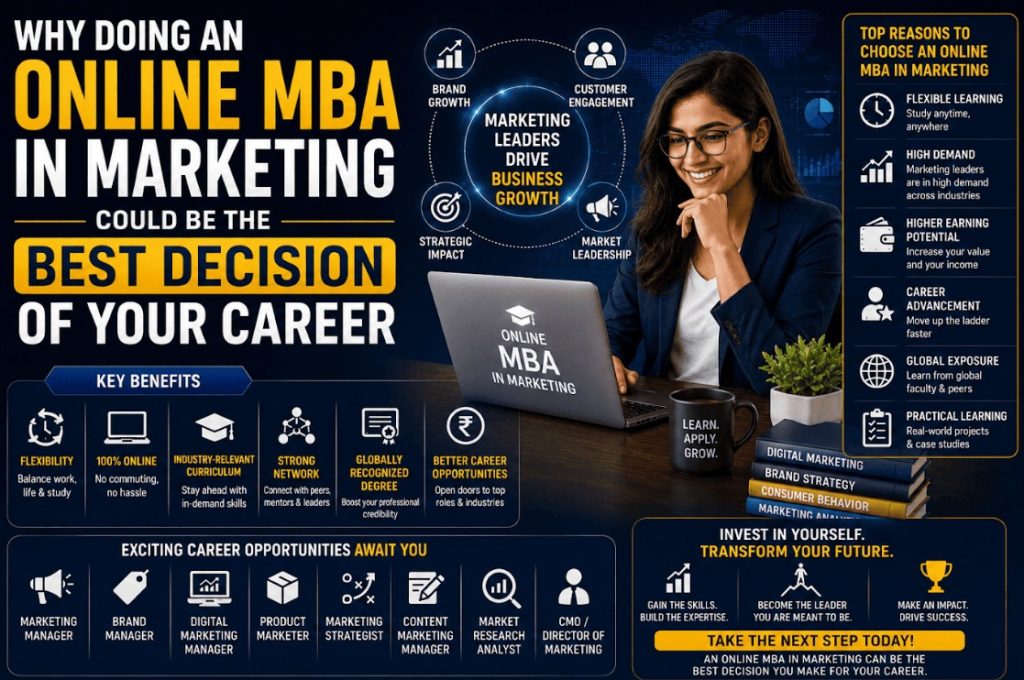
It’s that everyone is saying the same thing. That’s partly why many young professionals are now exploring online MBA Courses like the Online MBA in Marketing. The goal isn’t just to learn marketing tools. It’s to build a profile that stands out in a market where almost everyone has similar qualifications.
Knowing Marketing and Understanding Business Are Not the Same Thing
What actually happens is this. The first job comes from knowing the tools. But a few years in, something shifts. The technical stuff stops being the main conversation. Suddenly, the manager wants to know about ROI, customer acquisition cost, and revenue contribution. And a lot of professionals realise they can answer the marketing questions but not the business ones.
That’s not a marketing problem. That’s a different gap entirely. This is also where many Online MBA Courses try to bridge the gap between marketing execution and business understanding. The people moving into senior roles aren’t always the strongest at running campaigns.
Sometimes they’re just the ones who figured out earlier how marketing connects to what the company is actually trying to do. Revenue. Growth. Customer retention. The stuff leadership actually cares about.
Most people discover this somewhere between year two and year four of their career. By which point they’ve already spent time wondering why they’re not moving forward the way they expected.
Why This Field Specifically
One thing that makes marketing different from a lot of career paths is that it doesn’t belong to one industry. Hospitals need it. Startups need it. Banks need it. Even government schemes need communication teams now.
So the demand doesn’t really dry up the way it does in fields that are more tied to specific sectors. But that also means competition is everywhere, not just in one corner of the job market.
A few years ago, knowing digital marketing was a skill that stood out. Now it’s almost an expectation. Everyone has done a course. Everyone has a certificate.
The bar keeps shifting upward, and knowing the tools is no longer the thing that separates people. Business understanding is becoming that thing. And that’s exactly what online MBA courses, like the online MBA in marketing, are built around.
The Honest Reason People Are Choosing Online MBA Courses
Not everyone can quit their job, move cities, and do a full-time MBA for two years. Most people have EMIs. Responsibilities. Careers they’ve already spent years building.
Stopping everything to go back to school is just not realistic for a large chunk of working professionals. That’s genuinely why TEFL Online MBA Courses like the online MBA in Marketing exist and why they’ve grown so much.
The flexibility part is obvious. Most Online MBA Courses are designed around the reality that working professionals cannot always commit to full-time education.
Evening classes, weekend learning, and studying at your own pace. But there’s something else worth mentioning that people don’t talk about enough. Working professionals who do Online MBA courses, like Online MBA in marketing, often get more out of the material than fresh graduates in classrooms. Because they have actual context.
They’re dealing with real problems at work every week. When a course covers customer acquisition strategy or marketing budgets, they’re not learning it abstractly. They’re connecting it to something they already know. That makes a difference in how much actually sticks.
Who This Actually Makes Sense For
Not everyone needs an Online MBA course like an online MBA in Marketing right now. Worth being clear about that. If someone is freelancing and building a client base, maybe a portfolio and certifications matter more at this stage.
If someone is already growing well in their current role, maybe the timing isn’t right. But for someone who feels like they’ve hit a ceiling. Who’s watching people around them move into senior positions and can’t quite figure out what’s different about them? Who wants to move from execution to strategy but doesn’t know how to make that jump.
This kind of programme can genuinely shift things. Also for freshers who want to enter the market with more than just a graduation degree. In 2026 the job market is competitive enough that coming in with a management qualification alongside your undergrad is not a weak position to be in.
One Mistake Worth Not Making
And this is honestly where people make the most avoidable mistakes. Someone sees an affordable fee, the website looks decent, and they enrol. Six months later they realise the syllabus hasn’t been updated in years, there’s no real support, and the university name gets blank stares from recruiters.
Check if it’s UGC-approved. Look at what subjects are actually covered. Ask whether there’s placement help or if you’re on your own after graduating. These aren’t complicated questions, but most students skip them entirely.
For students comparing online MBA Courses like the Online MBA in Marketing across different universities, College Vidya is useful here . Instead of going through ten different university websites trying to piece together comparisons, you can see fees, approvals, curriculum details, and outcomes in one place for free. For a decision that costs real money and real time, having that clarity before enrolling just makes sense.
The Bigger Point
Marketing as a field isn’t going anywhere. But what it means to be good at it is changing. Technical skills are getting more common. Business understanding is becoming the thing that separates people who plateau from people who keep growing.
An Online MBA course, like an online MBA in Marketing, is one way to build that understanding without pausing everything else. It won’t replace effort or consistency; nothing does.
But it gives you something that a lot of purely technical backgrounds don’t, a framework for thinking about business, not just campaigns. And in a market where everyone has a degree and everyone claims to know digital marketing, that extra layer starts to matter more than people expect.