Procurement managers sourcing custom sheet metal fabrication services often encounter a frustrating paradox: a low quote that translates into a high total cost of ownership. The promise of savings evaporates with production delays, inconsistent quality, and deformed parts that fail in assembly. This undermines project timelines and erodes profit margins, turning a strategic procurement into a source of recurring operational headaches.
The root cause lies in a lack of deep process validation. Many suppliers operate on a foundation of educated guesses rather than data-driven, engineered processes. They may lack the systemic integration of standards like IATF 16949 into their daily workflows, turning the manufacturing of complex parts into a high-risk gamble. This article provides a comparative analysis of leading global manufacturers and presents a four-tier supplier audit framework. This methodology moves beyond price comparison, empowering readers to make quantifiable, low-risk technical decisions that ensure reliability, performance, and true cost savings.
Why is a Scientific Material Selection Guide Essential for Precision Manufacturing?
The foundation of any successful industrial fabrication project is the material itself. An incorrect or poorly specified alloy is a predetermined point of failure, regardless of machining precision. A scientific material selection guide transforms this critical decision from a best guess into a rigorous engineering exercise, directly linking material properties to part performance and longevity.
The High Cost of Material Misapplication
- Selecting a material based solely on cost or general availability is a primary risk. Using A36 mild steel in a saline environment guarantees rapid corrosion, while specifying overly hard, high-strength steel for a part requiring complex bends leads to cracking and springback. These errors manifest as premature part failure, unplanned downtime, and expensive field replacements. A structured guide prevents this by evaluating the operating environment — load, temperature, chemical exposure — against material properties like yield strength, corrosion resistance, and formability.
- Engineering Materials Science in Practice: Top-tier manufacturers act as applied materials engineers. They don’t just process metal; they consult on the optimal alloy and temper for the application. For instance, they understand that 5052-H32 aluminum offers superior formability for deep-drawn housings, while 6061-T6 provides better machinability for structural brackets. This expertise is grounded in authoritative standards like SAE J404, which defines the precise chemical composition required to achieve predictable mechanical properties, ensuring the material behaves as intended in the final product.
- The Guide as a Risk Mitigation Tool: A professional selection guide serves as a preventive risk management document. It systematically eliminates unsuitable options, forcing consideration of secondary factors like weldability, anodizing response, and compatibility with intended surface finishes. By following a disciplined selection process, engineers avoid the costly trial-and-error phase and ensure the chosen material is manufacturable, durable, and cost-effective for its entire lifecycle. Engaging with a partner that provides this level of professional sheet metal fabrication services is the first step in de-risking the design and ensuring a successful outcome.
How Do Protolabs and Fictiv Competitors Optimize Sheet Metal Forming Services?
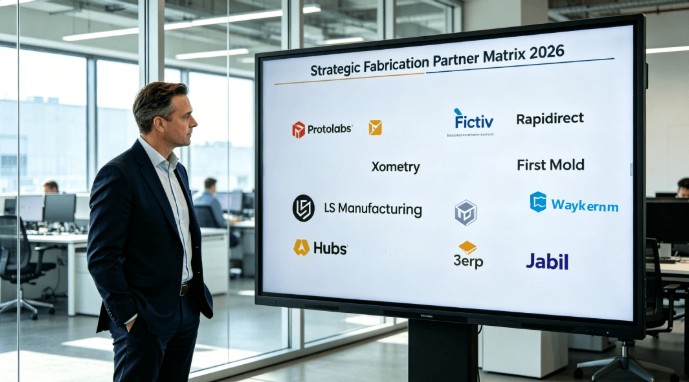
Digital manufacturing platforms like Protolabs, Fictiv, and Xometry have revolutionized access to rapid prototyping with their automated quoting and streamlined workflows. Their strength lies in speed and accessibility for standardized parts. However, when projects demand complex, non-standard sheet metal forming services — such as intricate multi-axis bends, deep draws, or assemblies with tight positional tolerances — the limitations of a fully automated model become apparent, and the value of a specialized, engineering-focused partner emerges.
1. The Automated vs. Engineered DFM Divide
Automated platforms provide fast, algorithm-based Design for Manufacturability (DFM) feedback. This is excellent for flagging clear violations like impossibly tight bend radii. However, they often lack the nuance to suggest optimized alternatives for challenging geometries. A dedicated engineering team at a specialized manufacturer can propose creative solutions: redesigning a tab to simplify a bend sequence, suggesting a different grain direction to prevent cracking, or recommending a material with better elongation for a deep draw. This human-led engineering collaboration often reveals cost and performance optimizations that algorithms miss.
2. Process Ownership and Specialized Equipment
Platforms typically aggregate jobs across a network of suppliers. For complex forming, this can introduce variability. A specialized manufacturer with in-house, advanced multi-axis press brakes and deep-draw stamping presses maintains direct control over the entire forming process. Their engineers program toolpaths, design custom dies, and fine-tune parameters on their own equipment. This vertical integration and process ownership ensure consistency and enable the manufacturer to tackle geometries that are infeasible or prohibitively expensive on standard, generalized equipment.
3. The Value Proposition for Complex Projects
For simple brackets or panels, the speed of a platform is unbeatable. For a complex chassis requiring precision welding, integrated hardware installation, and cosmetic finishing, the value shifts. A specialized partner manages the entire value stream in a controlled environment, ensuring that forming, welding, and finishing processes are perfectly synchronized. This end-to-end control reduces communication overhead, prevents quality escapes between different vendors, and ultimately provides a more reliable, predictable, and often more economical solution for sophisticated sheet metal fabrication for custom parts.
Is Your Supplier’s Quality Shield Built on IATF 16949 Standards?
A quality management system is often symbolized by a certificate on the wall. The critical question is whether it is a living, breathing framework that actively prevents defects, or merely a documentary exercise. Standards like ISO 9001 establish a baseline for systematic management, but IATF 16949 represents a fundamentally different philosophy: a proactive, risk-based system engineered for the relentless consistency demanded by the automotive industry and beyond.
1. Prevention Over Detection: The Core Philosophy
ISO 9001 focuses on establishing processes and ensuring they are followed. IATF 16949 mandates tools for preventing defects before they occur. It requires rigorous Failure Mode and Effects Analysis (FMEA) for both product design and manufacturing processes. For a sheet metal enclosure, this means proactively identifying and mitigating risks like weld splatter causing short circuits or a mis-located hole causing assembly misalignment. This upfront investment in prevention is vastly more cost-effective than inspecting for and repairing failures later.
2. Statistical Process Control and Continuous Improvement
IATF 16949 embeds Statistical Process Control (SPC) into production. It’s not enough to measure a few parts; key characteristics must be monitored with control charts to detect process drift before it produces out-of-spec parts. Furthermore, it enforces a culture of continuous improvement, requiring systematic analysis of any non-conformance to find its root cause and implement a permanent corrective action. This creates a self-correcting, ever-improving manufacturing system.
3. Traceability and Change Control: Non-Negotiable Disciplines
The standard demands absolute traceability. Every part batch must be linked to its specific material heat number, production run, and inspection records. It also imposes ironclad engineering change control. Any modification to a process, material, or design triggers a formal review and re-validation process. For buyers, this means that a supplier certified to IATF 16949 doesn’t just promise quality; they provide an auditable, systemic guarantee of consistency and control, which is the bedrock of reliable custom sheet metal fabrication services.
Why Should Engineers Audit Precision Sheet Metal Components Manufacturers Beyond Pricing?
A comprehensive audit of a precision sheet metal components manufacturer must penetrate far deeper than a price list. It should evaluate the technical decision-making logic, operational maturity, and industry-specific compliance that determine whether a supplier can deliver not just parts, but predictable success. Comparing different models, from the aggregated networks of Hubs to the specialized focus of manufacturers like 3ERP, reveals where true capability resides.
1. Interrogating the Technical Decision-Making Process
The audit should test a supplier’s engineering rationale. Present a challenging design: a thin-walled titanium housing with a complex bend. Ask not just “can you make it?” but “how will you make it?” Evaluate their response. Do they discuss tooling strategies, springback compensation values derived from historical data, and methods to control heat input during welding? Their answers reveal whether they rely on standardized procedures or possess deep applied knowledge to engineer a solution.
2. Assessing Operational Transparency and Control
Investigate their quality and production control systems. Do they use real-time SPC dashboards on the shop floor? Can they provide sample First Article Inspection (FAIR) reports that include full CMM data and material certifications? For regulated industries, can they demonstrate a validated process for cleanroom assembly or documented welding procedures? This operational transparency is a direct indicator of their ability to manage complexity and ensure batch-to-batch consistency.
3. The Criticality of Industry-Specific Compliance
Finally, the audit must verify industry-specific compliance. A manufacturer serving medical device companies must have a working understanding of ISO 13485 and FDA QSR requirements. One serving automotive must be adept at Production Part Approval Process (PPAP). This goes beyond holding a certificate; it’s about proving that compliance is baked into everyday work. When evaluating precision sheet metal components manufacturers, their proven track record and specific protocols for your industry are the ultimate test of their fitness as a strategic partner.
How Manufacturing Redefined Reliability for a Complex Industrial Project?
A concrete case demonstrates the impact of a manufacturer that replaces process variability with engineering certainty. A global industrial equipment maker faced a critical challenge: a complex sensor mounting bracket, with positional tolerances under ±0.1mm, was suffering from chronic delivery delays and inconsistent quality from their previous supplier, a platform similar to WayKen. The issues threatened the launch of a new product line.
1. The Root Cause Analysis: Uncontrolled Process Variables
A Manufacturing conducted a forensic analysis of the failing parts. The root causes were identified as uncompensated thermal distortion during laser cutting and inconsistent springback during bending due to a lack of material-specific data. The previous supplier’s process was reactive, making adjustments only after bad parts were produced, leading to a stop-start production cycle and low yield.
2. The Engineered Solution: Systemizing Precision
The solution was a complete process redesign grounded in the AS9100D aerospace quality management system. Manufacturing engineers first created a digital twin of the manufacturing process, simulating thermal effects to pre-compensate the laser cutting path. For bending, they developed a customized press brake program with precise, data-driven overbend angles specific to the alloy’s lot. In-process probing was added to verify critical hole locations before parts left the machine, creating a closed-loop quality system.
3. The Quantifiable Outcome: Predictable Performance
The results were transformative. The project achieved a first-pass yield of 99.8%, eliminating scrap and rework. More importantly, on-time delivery reliability reached 100%, seamlessly supporting the client’s assembly line. The total cost of the bracket was reduced by 18% when accounting for the elimination of downtime, sorting, and expedited freight. This case proved that for high-complexity parts, investing in a partner with certified engineering systems and deep technical control is the most reliable path to securing supply chain performance and cost targets.
What Questions Reveal a Supplier’s Expertise in CNC Machining Services and Fabrication?
The most telling evaluation of a supplier’s capability is a targeted technical interview. Moving beyond generic questions to specific, challenging inquiries about laser cutting, CNC machining services, and assembly integration separates true experts from basic job shops. The quality of their answers reveals their depth of knowledge, problem-solving approach, and commitment to precision manufacturing.
- Probing Metallurgical and Process Knowledge: Ask detailed questions about material behavior: “For this 304 stainless part, how do you program the laser to minimize the heat-affected zone (HAZ) and what is your target HAZ width?” or “This aluminum part has a tapped hole near a bend. What is your hole-to-bend distance rule, and how do you prevent thread distortion?” Expert answers will reference material datasheets, discuss gas selection (e.g., Nitrogen vs. Oxygen), and explain fixturing strategies to maintain hole geometry during forming.
- Assessing Integration and Secondary Process Capability: For projects requiring integrated fabrication, ask: “This assembly requires welded studs. What weld procedure specification (WPS) do you qualify to, and how do you control distortion across this large panel?” or “These parts need a conductive finish. How do you ensure anodizing coverage in deep channels, and what mil thickness do you guarantee?” Their response should demonstrate control over the entire value stream, from primary cutting to final finishing and validation.
- Evaluating Quality Philosophy and Data Integrity: Finally, interrogate their quality assurance methodology: “For this critical flatness requirement, do you perform 100% inspection with a CMM, or use SPC? Can you share a sample control chart?” and “What is your process for managing engineering changes, and how is that communicated to the shop floor?” A supplier that provides data, discusses measurement system analysis, and has a formal change control board demonstrates the maturity needed for producing reliable custom metal parts at any volume.
Conclusion
Selecting the right sheet metal fabrication manufacturer is a strategic audit, not a simple transactional purchase. By critically evaluating a supplier’s material science expertise, the robustness of their quality management systems (like IATF 16949 and AS9100D), and their ability to provide deep engineering collaboration beyond automated quoting, companies can secure a decisive long-term advantage. This disciplined approach transforms procurement from a cost center into a source of reliability, innovation, and sustainable competitive edge, ensuring that every custom part is an asset, not a liability.
FAQs
Q: How does IATF 16949 certification benefit a buyer of precision sheet metal fabrication services?
A: IATF 16949 mandates proactive risk management (like PFMEA) and statistical process control, moving beyond basic ISO 9001. For a buyer, this means the manufacturer systematically prevents defects rather than just finding them, resulting in significantly lower failure rates, more predictable lead times, and lower total cost by eliminating scrap, rework, and line stoppages.
Q: Why should engineers compare Xometry and Protolabs with specialized manufacturers?
A: Platforms like Xometry and Protolabs excel at speed for simple, standardized parts via automated workflows. For complex geometries, tight tolerances, or specialized materials, a specialized manufacturer provides deeper engineering collaboration and process ownership, offering optimized, flexible solutions that automated algorithms may miss, ensuring part performance and manufacturability.
Q: What are the risks of ignoring a Sheet Metal Material Selection Guide in Industrial Fabrication?
A: Ignoring a scientific Material Selection Guide leads to premature failure (corrosion, cracking) and unnecessary costs. Different alloys behave uniquely under stress, laser cutting, and bending. A guide based on standards like SAE J404 ensures the material’s chemical and mechanical properties match the design intent, preventing costly rework and ensuring part longevity.
Q: How do AS9100D standards impact the quality of precision sheet metal components manufacturers?
A: AS9100D, the aerospace standard, demands extreme traceability and process control. For a manufacturer, it means every material lot and production step is documented and auditable. For the buyer, sourcing from an AS9100D-certified partner guarantees a level of consistency and reliability that standard shops cannot match, which is critical for medical, aerospace, and other high-stakes applications.
Q: Is a digital Instant Quote system always the best indicator of a supplier’s CNC Machining Services capability?
A: Not necessarily. An Instant Quote shows algorithmic efficiency, not engineering depth. While valuable for speed, the true indicator of capability is the quality of DFM feedback provided. A supplier that combines digital efficiency with human-led engineering consultation ensures technical rationale is applied to your project, preventing costly errors that purely automated systems might overlook.
Author Bio
The insights in this article are contributed by a manufacturing solutions expert specializing in high-complexity fabrication challenges. The expert, from LS Manufacturing, supports engineers and procurement leaders in ensuring part performance and supply chain reliability through integrated precision sheet metal fabrication services, leveraging certified quality systems (IATF 16949, AS9100D, ISO 9001) and deep technical collaboration.